Currently Empty: R0.00

Reverse Osmosis vs Water Filtration: Which System Is Best for Your Water?
When comparing reverse osmosis vs water filtration, many people assume they are simply two names for the same thing. In reality, they are very different technologies designed to solve different water quality problems.
Choosing the wrong system can leave contaminants untreated, increase maintenance costs, or result in paying for equipment you don’t actually need. The right choice depends on your water source, the contaminants present, your daily water usage, and the purpose of the water.
Whether you use municipal water or borehole water, the smartest first step is always a professional laboratory water analysis. Once you understand what’s in your water, selecting the correct treatment system becomes straightforward.
Why This Comparison Matters
Every week, homeowners and businesses ask questions such as:
- Is reverse osmosis better than a normal water filter?
- Do I need reverse osmosis at home?
- Will a carbon filter remove bacteria?
- Can filtration remove hard water?
- Is reverse osmosis necessary for municipal water?
- Which system is best for borehole water?
These are important questions because no single technology can solve every water quality problem.
Each treatment method has strengths and limitations.
Understanding those differences helps you make an informed investment.
What Is Water Filtration?
Water filtration is a broad term describing technologies that remove specific contaminants from water.
Different filters target different problems.
Examples include:
- Sediment filters.
- Activated carbon filters.
- Multimedia filters.
- Iron removal filters.
- Manganese filters.
- Water softeners.
- Ultraviolet (UV) sterilisation systems.
Each serves a specific purpose.
In many cases, several filtration stages work together to achieve the desired water quality.
What Does a Sediment Filter Remove?
Sediment filters are usually the first stage in many water treatment systems.
They remove physical particles such as the following:
- Sand.
- Dirt.
- Rust.
- Silt.
- Mud.
- Suspended solids.
These filters protect downstream equipment such as pumps, UV sterilisers, and reverse osmosis membranes.
However, sediment filters do not remove:
- Dissolved salts.
- Hardness.
- Heavy metals.
- Bacteria.
- Viruses.
- Chlorine.
- Bad tastes.
- High TDS.
What Does an Activated Carbon Filter Remove?
Activated carbon improves the aesthetic quality of water.
It is particularly effective at reducing:
- Chlorine.
- Unpleasant tastes.
- Odours.
- Organic compounds.
- Certain pesticides.
- Some industrial chemicals.
This makes activated carbon an excellent option for municipal drinking water where chlorine taste is the primary concern.
However, activated carbon does not remove:
- Dissolved salts.
- Calcium.
- Magnesium.
- Nitrates.
- Fluoride.
- Most heavy metals.
- Total Dissolved Solids (TDS).
What Does a Water Softener Do?
Many people believe a water softener purifies water.
It doesn’t.
A water softener is designed specifically to remove hardness minerals such as the following:
- Calcium.
- Magnesium.
By reducing hardness, water softeners help prevent:
- Scale build-up.
- Blocked pipes.
- Geyser damage.
- Boiler scaling.
- Appliance wear.
Water softeners improve the performance of hot water systems and extend the lifespan of household and commercial equipment.
What Does UV Sterilisation Do?
Ultraviolet systems use high-intensity UV light to deactivate microorganisms.
UV treatment is effective against:
- Bacteria.
- Viruses.
- Protozoa.
However, UV systems only disinfect water.
They do not remove:
- Dirt.
- Iron.
- Hardness.
- Dissolved salts.
- Heavy metals.
- Bad taste.
- Odours.
- Chemical contaminants.
For UV to work effectively, the water usually needs proper pre-filtration.
What Is Reverse Osmosis?
Reverse osmosis is one of the most advanced water purification technologies available.
Instead of filtering only visible particles, it forces water through a semi-permeable membrane under pressure.
This membrane removes an exceptionally wide range of dissolved contaminants.
A professionally designed reverse osmosis system can significantly reduce:
- Total Dissolved Solids (TDS).
- Sodium.
- Calcium.
- Magnesium.
- Nitrates.
- Fluoride.
- Sulphates.
- Chlorides.
- Heavy metals.
- Many harmful contaminants.
The result is exceptionally high-quality drinking water suitable for homes, commercial facilities, and industrial applications.
How Reverse Osmosis Differs from Standard Filtration
This is where many buyers become confused.
Traditional filtration removes specific contaminants depending on the filter media used.
Reverse osmosis removes many dissolved contaminants simultaneously, making it a far more comprehensive purification technology.
However, that does not mean every customer requires reverse osmosis.
For some municipal water supplies, simple filtration combined with activated carbon may be entirely sufficient.
For other water sources—particularly many boreholes—reverse osmosis may be essential.
Again, the answer lies in a professional laboratory water analysis.
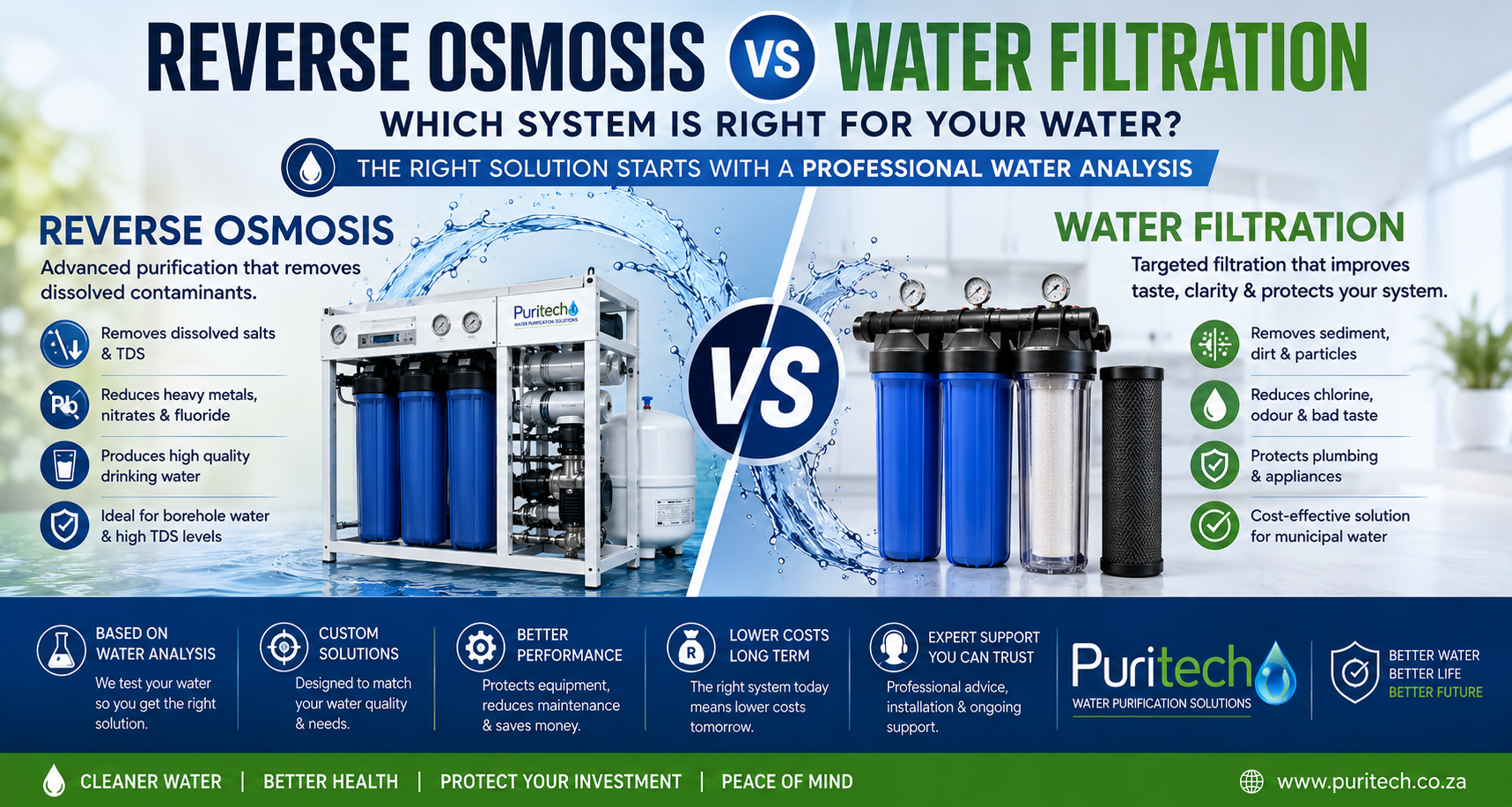
Reverse Osmosis vs Water Filtration: Quick Comparison
| Feature | Water Filtration | Reverse Osmosis |
|---|---|---|
| Removes dirt and sediment | ✅ Yes | ✅ Yes (with pre-filtration) |
| Improves taste and odour | ✅ Yes (carbon filters) | ✅ Yes |
| Removes chlorine | ✅ Yes | ✅ Yes |
| Removes hardness | Only with a water softener | ✅ Significantly reduces hardness |
| Removes dissolved salts | ❌ No | ✅ Yes |
| Reduces TDS | ❌ No | ✅ Yes |
| Removes nitrates | ❌ No | ✅ Yes |
| Reduces fluoride | ❌ No | ✅ Yes |
| Removes many heavy metals | Limited | ✅ Yes |
| Suitable for highly contaminated water | Sometimes | ✅ Often the preferred choice |
The Biggest Myth
One of the biggest misconceptions is that reverse osmosis is always better.
That simply isn’t true.
If your municipal water is already of good quality and only has a slight chlorine taste, installing a full reverse osmosis system may be unnecessary.
Likewise, relying only on a carbon filter for heavily contaminated borehole water may leave significant contaminants untreated.
The best system is the one designed specifically for your water.
Reverse Osmosis vs Water Filtration for Different Applications
Now that we’ve explained the difference between reverse osmosis vs water filtration, the next question is even more important:
Which system is right for your specific water?
The answer depends on several factors, including:
- Your water source.
- The results of your professional laboratory water analysis.
- Your daily water consumption.
- The purpose of the water.
- Your future water requirements.
There is no universal solution.
A family home has very different requirements from a hotel, hospital, food factory or mine.
Let’s look at the most common applications.
Municipal Water
Most municipal water in South Africa has already undergone treatment before reaching your property.
However, this doesn’t mean every municipal supply is identical.
Some areas experience:
- High chlorine levels.
- Unpleasant taste.
- Sediment after pipe repairs.
- Elevated hardness.
- Old distribution infrastructure.
- Intermittent supply interruptions.
When Water Filtration Is Usually Enough
If laboratory results show good overall water quality with only aesthetic concerns, a filtration system may be the ideal solution.
Typical systems include the following:
- Sediment filtration.
- Activated carbon filtration.
- UV sterilisation (where required).
These systems improve:
- Taste.
- Odour.
- Water clarity.
- Drinking quality.
while protecting plumbing and household appliances.
When Reverse Osmosis Is Recommended
If municipal water analysis shows elevated levels of the following:
- Total Dissolved Solids (TDS).
- Sodium.
- Nitrates.
- Fluoride.
- Other dissolved contaminants.
then reverse osmosis may provide significantly better drinking water quality.
Borehole Water
Borehole water varies dramatically from one property to another.
Even neighbouring properties may produce completely different laboratory results.
Common borehole issues include:
- High iron.
- High manganese.
- Elevated hardness.
- High TDS.
- Low pH.
- Sulphates.
- Chlorides.
- Nitrates.
- Microbiological contamination.
Because of this variability, no responsible supplier should recommend equipment before reviewing a recent laboratory water analysis.
Water Filtration for Boreholes
Where contaminants are limited to:
- Sediment.
- Iron.
- Manganese.
- Moderate hardness.
Specialised filtration systems may provide excellent results.
Reverse Osmosis for Boreholes
Where laboratory results indicate elevated dissolved salts or multiple contaminants, reverse osmosis often becomes an essential part of the treatment process.
However, reverse osmosis should almost always be protected by appropriate pretreatment to maximise membrane life and reduce maintenance costs.
Homes and Residential Properties
Most homeowners simply want the following:
- Safe drinking water.
- Better taste.
- Cleaner appliances.
- Less maintenance.
The appropriate solution depends entirely on the water quality.
Typical Filtration Systems
Ideal when the objective is:
- Better tasting water.
- Chlorine removal.
- Sediment removal.
- Improved clarity.
Reverse Osmosis Systems
Recommended where exceptionally high-quality drinking water is required or laboratory analysis indicates contaminants that standard filtration cannot remove.
Apartments and Residential Estates
Apartment developments often require centralised water treatment.
Depending on water quality, this may include the following:
- Sediment filtration.
- Activated carbon.
- Water softening.
- UV sterilisation.
- Reverse osmosis for dedicated drinking water points.
Proper system design ensures reliable water quality while controlling maintenance costs.
Hotels and Guest Houses
Guest satisfaction depends heavily on water quality.
Poor-tasting water, stained bathroom fittings and scale build-up all affect the customer experience.
Hotels often benefit from a combination of technologies.
For example:
- Water softening to protect boilers and geysers.
- Carbon filtration to improve taste.
- Reverse osmosis for premium drinking water.
- UV sterilisation where microbiological protection is required.
Restaurants and Coffee Shops
Water directly affects:
- Coffee quality.
- Tea flavour.
- Ice production.
- Food preparation.
- Equipment reliability.
Many coffee machines fail prematurely because untreated hard water forms scale inside the boilers.
In these environments, the correct treatment system not only improves beverage quality but also protects expensive equipment.
Hospitals and Healthcare Facilities
Healthcare facilities demand exceptionally reliable water quality.
Applications include:
- Drinking water.
- Sterilisation.
- Laboratories.
- Dialysis support.
- Staff facilities.
- Kitchens.
- Laundry services.
Treatment systems are often customised according to each department’s specific requirements.
Because patient safety is involved, professional engineering and ongoing maintenance are essential.
Schools and Universities
Educational institutions consume large volumes of water every day.
Typical treatment objectives include the following:
- Safe drinking water.
- Improved taste.
- Reduced maintenance.
- Protection of plumbing infrastructure.
- Reliable operation during peak demand.
Depending on laboratory results, filtration alone may be sufficient, while some facilities require additional treatment technologies.
Food and Beverage Manufacturing
Food manufacturers require consistent water quality.
Even slight variations may affect:
- Product taste.
- Product consistency.
- Cleaning processes.
- Steam production.
- Production efficiency.
Reverse osmosis is frequently used where exceptionally consistent water quality is required, although many facilities also require specialised pretreatment.
Manufacturing Plants
Industrial manufacturing often uses water for:
- Cooling.
- Cleaning.
- Chemical mixing.
- Production processes.
- Equipment washing.
Treatment requirements depend on the manufacturing process itself.
Proper engineering ensures equipment protection while reducing maintenance and operating costs.
Agriculture and Farming
Farmers use water for:
- Livestock.
- Irrigation.
- Dairy operations.
- Poultry.
- Packhouses.
Borehole water is particularly common.
Because agricultural boreholes vary significantly, laboratory analysis remains the starting point for selecting appropriate treatment technologies.
Mining Operations
Mining presents some of the most demanding water treatment applications.
Water may require treatment for:
- Process water.
- Dust suppression.
- Employee facilities.
- Equipment protection.
- Cooling systems.
These systems are typically engineered around detailed laboratory results and operational requirements.
The Biggest Buying Mistake
Many customers ask:
“Which system should I buy?”
The better question is the following:
“What does my water require?”
Buying equipment before understanding the water often results in:
- Overspending.
- Poor performance.
- Increased maintenance.
- Equipment damage.
- Customer disappointment.
Professional laboratory analysis removes the guesswork.
Real-World Example
A family relying on borehole water contacted Puritech because their neighbours had installed a reverse osmosis system and recommended they do the same.
Instead of immediately supplying the same equipment, Puritech requested a recent laboratory water analysis.
The results showed:
- Low TDS.
- No significant dissolved salts.
- Slight iron contamination.
- Moderate sediment.
Rather than recommending a costly reverse osmosis system, Puritech designed a filtration solution with sediment filtration, iron removal, and activated carbon.
The family achieved excellent drinking water quality at a significantly lower cost while reducing future maintenance requirements.
The lesson was simple:
The best system wasn’t the most expensive—it was the one designed for their water.
One Size Never Fits All
The comparison between reverse osmosis vs water filtration isn’t about deciding which technology is superior.
It’s about understanding which technology solves your specific water quality challenges.
In many cases, the best solution combines several treatment technologies into one integrated system.
The only reliable way to make that decision is through a professional laboratory water analysis followed by expert system design.
Common Buying Mistakes When Choosing Between Reverse Osmosis and Water Filtration
Understanding the difference between reverse osmosis vs water filtration is only the first step. The next challenge is selecting the right solution for your specific water quality.
Every year, homeowners and businesses spend thousands of rand on equipment that either doesn’t solve the problem or is far more advanced than necessary. In most cases, the mistake isn’t buying poor-quality equipment—it’s buying the wrong type of equipment.
Here are the most common mistakes and how to avoid them.
Mistake 1: Buying Without a Professional Water Analysis
This is by far the biggest mistake.
Many customers purchase equipment based on:
- Internet reviews.
- Recommendations from friends.
- Social media posts.
- Online advertisements.
- The lowest quotation.
Unfortunately, none of these sources knows what’s actually in your water.
A professional laboratory water analysis identifies:
- Hardness.
- Total Dissolved Solids (TDS).
- Iron.
- Manganese.
- pH.
- Fluoride.
- Nitrates.
- Sulphates.
- Chlorides.
- Microbiological contaminants where applicable.
Without this information, selecting a treatment system is little more than guesswork.
Mistake 2: Assuming Reverse Osmosis Is Always Better
Reverse osmosis is one of the most effective purification technologies available.
However, more treatment is not always better treatment.
If your municipal water is already of excellent quality and only contains chlorine taste and odour, an activated carbon filtration system may provide everything you need.
Installing reverse osmosis where it isn’t required may:
- Increase installation costs.
- Increase maintenance.
- Produce unnecessary wastewater.
- Add replacement membrane costs.
The objective is not to install the most advanced equipment.
The objective is to install the most appropriate equipment.
Mistake 3: Assuming Filtration Solves Every Water Problem
The opposite mistake is equally common.
Many customers believe that a basic water filter removes everything.
It doesn’t.
Depending on the filter type, standard filtration may not remove:
- Dissolved salts.
- High TDS.
- Fluoride.
- Nitrates.
- Sodium.
- Many heavy metals.
If these contaminants are present, additional treatment such as reverse osmosis may be required.
Again, the answer comes from laboratory analysis—not assumptions.
Mistake 4: Ignoring Pretreatment
Pretreatment is one of the most important parts of any water treatment system.
For example, reverse osmosis membranes should be protected from contaminants such as the following:
- Sediment.
- Iron.
- Manganese.
- Excessive hardness.
- Organic matter.
Without adequate pretreatment, membrane life may be dramatically reduced.
A properly engineered system protects expensive components while lowering long-term operating costs.
Mistake 5: Buying the Cheapest System
Price is important.
Value is even more important.
Two systems may appear similar while using completely different quality components.
Differences may include:
- Pump quality.
- Membrane quality.
- Pressure vessels.
- Pipework.
- Electrical components.
- Automation.
- Technical support.
- Warranty.
- Availability of replacement parts.
A slightly higher initial investment often delivers substantially lower lifetime costs.
Mistake 6: Forgetting About Maintenance
Every water treatment system requires maintenance.
Ignoring scheduled servicing may result in:
- Reduced water quality.
- Lower flow rates.
- Equipment damage.
- Increased electricity consumption.
- Premature component failure.
Routine maintenance protects both water quality and your investment.
A Simple Decision Guide
If you’re unsure whether to choose reverse osmosis vs. water filtration, start by answering these questions.
Is your water supplied by a municipality?
If yes, basic filtration may be sufficient for taste, odour, and sediment.
However, if laboratory results reveal elevated dissolved contaminants, reverse osmosis may provide superior drinking water quality.
Do you use borehole water?
If yes, never select treatment equipment without a recent professional laboratory water analysis.
Borehole water varies significantly, even between neighbouring properties.
Is your concern mainly taste and chlorine?
Activated carbon filtration often provides an excellent solution.
Are you experiencing hard water?
A water softener may be the correct solution.
Is your TDS unusually high?
Reverse osmosis is often recommended for reducing dissolved salts and improving drinking water quality.
Are you treating water for a commercial or industrial process?
Commercial and industrial applications almost always require custom engineering based on laboratory results and operational requirements.
Why Professional Advice Matters
Selecting water treatment equipment is similar to selecting the correct medicine.
The symptoms may appear obvious.
The underlying cause may be completely different.
Professional engineers evaluate:
- Laboratory water analysis.
- Water source.
- Daily consumption.
- Peak demand.
- Future expansion.
- Intended application.
- Maintenance requirements.
- Operating costs.
Only then can the most appropriate solution be recommended.
Why Customers Choose Puritech
At Puritech, we don’t believe in selling the same system to every customer.
Every recommendation begins with understanding the water.
Our process includes:
- Professional consultation.
- Review of laboratory water analysis reports.
- Custom system design.
- Equipment supply.
- Professional installation.
- Commissioning.
- Preventative maintenance.
- Technical support.
- Future upgrades.
Whether you require drinking water for your home, process water for manufacturing, borehole treatment for a farm, or commercial purification for a hotel or hospital, our objective is the same:
Design the right solution for your water—not someone else’s.
Frequently Asked Questions
Is reverse osmosis better than water filtration?
Not necessarily.
Reverse osmosis removes a broader range of dissolved contaminants, but many applications only require filtration. The correct choice depends on your water quality and intended use.
Can I install reverse osmosis on municipal water?
Yes.
However, if your municipal water is already of good quality, reverse osmosis may not always be necessary. A professional laboratory water analysis helps determine the most suitable option.
Does a carbon filter remove bacteria?
No.
Activated carbon improves taste and removes chlorine and certain organic compounds, but it is not designed to disinfect water.
Can reverse osmosis remove hardness?
Yes.
Reverse osmosis significantly reduces calcium and magnesium, which are responsible for hard water.
Why should I analyse my water before buying a treatment system?
Laboratory analysis identifies the contaminants present, allowing engineers to recommend the most effective and cost-efficient treatment solution.
Final Thoughts
When comparing reverse osmosis vs water filtration, there is no single winner.
Each technology has an important role to play.
The best choice depends on the quality of your water, your application, and your long-term goals.
A homeowner with good municipal water may only require activated carbon filtration.
A family using a borehole with elevated dissolved salts may benefit from reverse osmosis combined with specialised pretreatment.
A hotel, hospital, school, food manufacturer, or mining operation may require a customised multi-stage treatment system engineered specifically for their water supply.
The common factor in every successful project is a professional laboratory water analysis.
At Puritech, we believe that understanding your water is the foundation of every reliable water treatment solution. By combining laboratory results with engineering expertise, we design systems that deliver excellent water quality, protect valuable equipment, and provide long-term value for homes, businesses, commercial facilities, and industrial operations throughout South Africa.
Don’t choose between reverse osmosis and water filtration based on marketing claims—choose the solution that’s right for your water.